AFGO: another fucking growth opportunity

At my therapy appointment last week, we talked about the frustrations I have with people interjecting themselves into this situation with Sammy… Being supportive is one thing, but throwing a fit because you’re not in the thick of it is inappropriate.

It was a really well timed visit honestly.

One of the hardest things about my nephew being ill is not knowing what is going to happen or be able to plan things. Obviously when any crisis like this affects my sister, I want to be there right away. I’m glad I waited and tried to plan better, because if I had gone right away I would likely have had to miss the surgery itself. That’s too important.

The uncertainty is hard. The out of control feeling is hard. The patience is hard.

My therapist told me to treat it like an AFGO – another fucking growth opportunity.
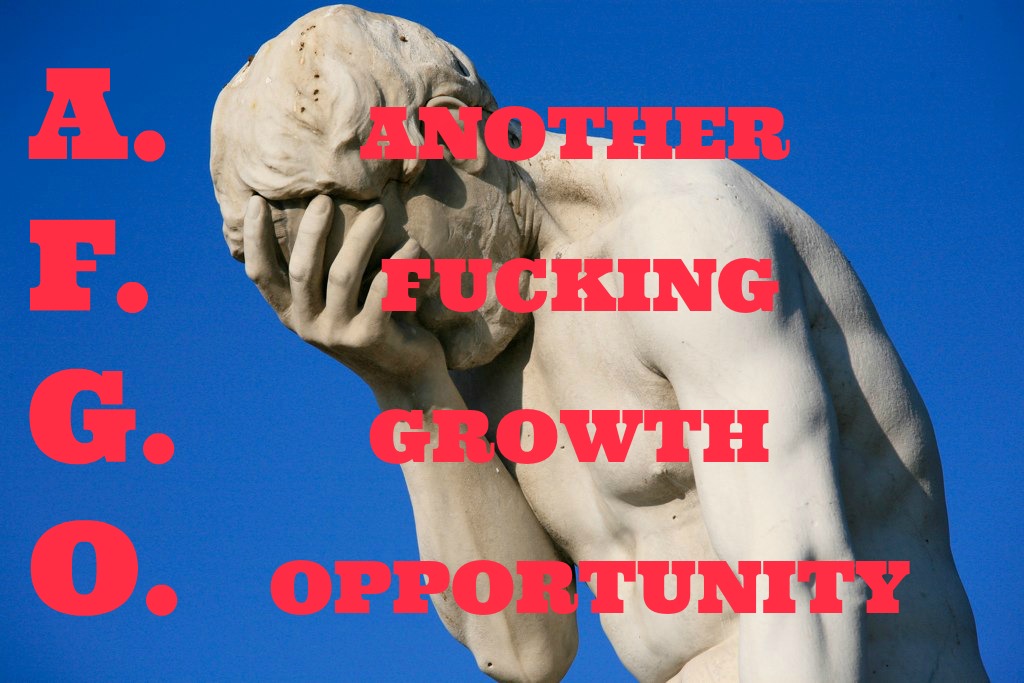
I certainly appreciate the idea, especially the bit about the cursing… and how it sounds like you’re fed up with the situation already.

Definitely, especially with you-know-who.

That’s how I’m going to approach this right all now – as multiple opportunities. It’s an AFGO. It’s an opportunity to see my sister, meet my nephew, and hang out with the fam. It’s an opportunity to see San Francisco and travel more.

Mostly, it’s an opportunity to be in a type of care coordination role. I need to make sure that this family is taking care of themselves and do what I can to help them with Sam and Marissa.

Terminology Tuesday: TAPVR

While this isn’t necessarily arthritis related, it’s obviously weighing heavily on my mind with my newborn nephew facing open heart surgery.

Total Anomalous Pumonary Venous Return (TAPVR) is a kind of Congenital Heart Defect (CHD) where the heart doesn’t connect to itself correctly. In fact, it’s listed as a Critical CHD, which means extra bad news.

It means he’s special medically just like me and his momma though – one out of 7200 babies every year is born with a CCHD in the US. That’s 1 in 4 of the 1 in 100 born with a CHD, or 1 in 400 children. TAPVR specific rates aren’t available, but would be much smaller due to how many CCHDs there are.

To understand it, we’re gonna need a quick rundown on how the heart works. Heads up for my boss for running through this with me last week (and to the CDC for having the best site). Can I just say again how much I love pediatric docs?

Blood that has run through the body loses oxygen. That’s why our veins are blue instead of red – the blood inside has lost oxygen. That blood has to come back to the heart to get oxygen again, and it does so through the superior and inferior vena cava.

The right atrium, where the blood enters the heart, acts like a mini reservoir in that blood collects there until it is pushed down through the tricuspid valve when the heart beats. It goes into the right ventricle and, when the heart beats, it gets pushed into the lungs via the pulmonary valve and main pulmonary artery.

The blood gets oxygen in the lungs and then comes back into the heart through the left atrium. Just like the right, the left atrium acts as a holding space until the heart beats and blood is pushed through the mitral valve into the left ventricle. The muscle here has to be very strong, because when the heart beats again, the blood has to go through the aortic valve and aorta to go out into the rest of the body.

If that doesn’t help, maybe this video will:


Got it? Kinda? Good!

In someone with TAPVR, the blood going out to the body carrying oxygen isn’t going out the right way.

As we can see in this picture, the blood with and without oxygen is all mixing together. Here’s what’s going on:

The unoxygenated blood comes back to the heart like normal and even goes out the the lungs like normal. However, the oxygen-rich blood coming back from the lungs has a problem.

Sam’s heart isn’t set up like a normal heart. TAPVR means that the pulmonary veins aren’t connected in the right spot. Instead of coming to the left atrium, the oxygenated blood goes back to the right atrium and starts the process again. The only reason Sam is getting any oxygen to his body is because there is also a small hole between both atriums, allowing both oxygen-rich and unoxygenated blood into the left atrium.

The blood going to his body isn’t oxygen rich and that causes problems.

There are a few types of TAPVR. Sam’s is infracardiac, meaning:

the pulmonary veins come together and form abnormal connections below the heart. A mixture of oxygen-poor blood and oxygen-rich blood returns to the right atrium from the veins of the liver and the inferior vena cava, which is the main blood vessel that brings oxygen-poor blood from the lower part of the body to the heart. (what up CDC)

The only way to correct this is to have open heart surgery. If you want to see what the surgery looks like, you can watch the graphic video here. It’s upsetting, so if you’re emotionally invested in this baby boy, stay away from the link or you’ll wind up in a puddle like me.

With it being a CCHD, he may need further care. Some kids need more surgeries. If things go really well, he’ll have to visit numerous specialists often for a long while.

This is not okay. No child should have to go through this.

Mental Health Monday: rant warning

Warning: rant time.

I’m writing this last Thursday, as Kelsey is getting ready to meet with Sam’s surgeons and I’m prepping for therapy.

I watched a video of the surgery Sammy will have on YouTube. Don’t do it. Ever.

I lost it at a point during the video while alone in my office. I can’t handle this. Not being there is killing me, and the longer I’m not there the worse it gets.

Kelsey needs me today. She needs me and I’m not there. I can hold things together mentally for a while, mostly when I talk to her, because I know she needs me to be the brain right now, to help think about and deal with things she might not have thought of yet – like the GoFundMe or facebook pages I set up before she was even awake the other day.

I’ve had a glass of wine every night for the last few nights. It’s the only way I’m getting any sleep, unless I want to use a muscle relaxer and then I can’t focus the next day if I have to wake up on a schedule.

When Kelsey had her seizure in 2009, I got this scared. There could’ve been a million things that caused that seizure and for a while we didn’t know if it was really bad. Thankfully, it seems like it was a random occurrence, but still. I held it together for Kelsey and lost it out of her sight (ie the bathroom because I didn’t want to leave her side).

I even tried to get her medical care for some serious issues she was going through and couldn’t because I wasn’t the parent… So unless I could house and raise my sister – and sued my mother for custody – I couldn’t get sis the right medical care. It’s bullshit.

I’ve always felt more like a parent than a sister, and I guess that’s what parents are supposed to do right? Be strong for those we love and then silently break down in the bathroom or the shower when no one’s watching?

Hell, I do that with Theron too. Maybe it’s just a me thing.

I’m upset that my mother is trying to make the situation about herself instead of about helping, about providing love and advice and a shoulder for Kelsey to lean on. I guess that’s what she’s always done though, so I really shouldn’t be surprised. It hurts that even in the hardest of times, she finds a way to do this.

Parents are supposed to help and do what’s best. That isn’t this. And I, as an older sibling, feel bad for not being the best parent right now.

Emotional incest for the win!

Side note to explore another day – I hate that I’m practically my mom’s ex. Again, emotional incest sucks.

UGH.

I’m ready for therapy, for my glass of wine, and for sleep. It’s not even 1 pm yet.

Self-Care Sunday: dealing with the past

Real talk: you do seriously need to watch this. If you haven’t yet:

Kimmy: I can’t even do a dream date right!
Titus: Probably because you’re bottling up the past. The past is not a root beer Kimmy Schmidt!

Today, we’re going to talk about what to do for yourself when you’re dealing with rough things from the past.

Do you feel like your should-be self is interfering with your right-now life? And who you want to be? Check out this piece. And if you feel like you were over some past things but recently discovered you weren’t, please please please read this post from Blessing Manifesting. Spot on.

It’s important in so many ways to both own and tell your story. Maybe you’re on the path to finding out your story and learning why it’s so important to share. Remember that there are always ways to get through the hard times.

Kimmy: Do you think going through something like that – a war or whatever – makes you a better person? Or, deep down, does it just make you bitter and angry?

Have you been abused by family or others too? There are lots of guides out there on how to heal, but I found this one helpful. One really tough part about all of this is figuring out that you contain worth and you matter. You’re not just taking up space. People like me often find comfort in becoming a bit of a control freak. In reality, we need to let go and work on how to deal with less emotional pain. Sometimes that means working through the abuse. Sometimes that means ignoring it. For others, that means focusing on the good that’s come out of the situation.

The important thing to remember is that standing up for yourself gives you the power in the relationship and negates much of the power they hold over you. Learn to say no and set up real and proper boundaries. It isn’t easy and you will have set backs, but believing in yourself and your experiences will help get you to where you need to be.

If you’re dealing with PTSD or other issues that cause flashbacks, learn about how and why they happen.

If you can’t remove yourself from a situation by cutting contact like I did, try these steps when you’re in a high pressure situation. It’s easier said than done to keep your cool, but it can help to step back from the emotions of the situation.

Make sure that you address all the dimensions of self care that there are. Help the others around you by talking about empathy and asking for help when you need it. If you need it, check out resources on DBT and other ways to get through crisis moments. Processing traumatic events is really hard. Maybe practice some self care? If you’re really stuck on that though, try helping someone else. It always makes me feel better.

It won’t be easy but you can make it – because you’re:

Therapeutic Thursday: the importance of sharing your truth

It can be really hard to stick to your guns when others act like you’re in the wrong on something. It’s even harder when that something has to do with your personal well being.

If you’re anything like me, you see standing up for yourself in some aspects as not worth the confrontation or conflict that may come along. You’ve been conditioned, whether through people or other influences in your life, to see yourself as unworthy, little, and puny. Sure, everyone has days like that. For some of us, that’s what makes up the bulk of our thoughts.

The biggest problem with growing up in a home or being in any position where you’re conditioned to think like this is that it affects every aspect of your life. It will make you think your bronchitis is just a cold – that you’re upplaying the affects of any illness or just unworthy of getting treatment – and that you don’t need to seek medical help. You don’t go for promotions or better jobs because you ‘just know’ you won’t get them. It affects your confidence to the point that if, by some miracle you did apply for a job, you wouldn’t get past the interview stage because you become a nervous and anxious wreck. Your personal relationships suck because you either have no friends or you have ‘friends’ who walk all over you and make you feel worse about yourself.

It’s almost as if every user can sense you’re a good usee.

On top of that, you get to deal with that little voice in the back of your head that reminds you how not good enough to accomplish things you are. Oftentimes, that voice is the voice of the bully or abuser or oppressor that you’ve dealt with.

A good way to combat these feelings is to be assertive and to speak your truth.

I know that speaking your truth sounds silly, but that’s exactly what it is – your truth. Just because your abuser didn’t see what she did as abuse doesn’t mean it isn’t. If you felt abused, that is your truth. No one has the right to tell a victim whether or not they were victimized.

These issues will just keep popping up until you get help and work on sharing what you’ve gone through. Not everyone is as into sharing as I am, but I believe that it really does help the healing process along for others to hear and know about why you’re triggered by the smell of beer or why people yelling at others bothers you.

Sharing can be a really hard step for a few reasons – the biggest perhaps is that sharing makes what you’ve gone through real. I began to talk with other abuse survivors and the things and stories we had in common were frightening honestly. It became more real to me.

Right now I am dealing with the realest feelings from the abuses I’ve suffered. I’m dealing with flashbacks that I have a really hard time getting out of. I’m dealing with pent up anger at remembering more and more things that happened as I was growing up. All this is happening because I’m sharing more in my relationships and in therapy. But it also means I’m working through these issues.

I am solid in the knowledge that I suffered through things a child shouldn’t even have to think about let alone endure or witness. I know for a fact that the adults in the home where I grew up have some serious personality and mental health issues that need to be addressed but likely never will. I am dealing with the fact that my family was not dysfunctional but abusive and that it stunted my emotional growth horribly.

I own everything that I am, including what has happened to me. In order to embrace myself – faults and all – I must embrace the scared little girl that still resides inside of me. I have to help her find her voice.

My mother can’t seem to keep herself out of my life. She continues to read what I’m doing here on this blog and trying to creep on me via multiple social media sites. My sister has been asked to rein me in to stop me from talking about what I’ve gone through.

I’m not a little girl anymore. I can’t be scared by comments that my sister will be taken away and my mother put in jail if I talk about the abuse or what happened in our home. I won’t be frightened into silence anymore.

And if you don’t like what I have to say, I have only one thing to say to you:

Your opinion doesn’t matter anyway.

Terminology Tuesday: NSAID

NSAID is such a common term used in arthritic and rheumatic diseases. NSAIDs are obviously used with other diseases, and in fact in many other ways.

NSAID stands for non-steroidal anti-inflammatory drug, which makes it pretty clear to see what it does on a superficial level. Without using steroids, these drugs help to bring swelling and other issues related to inflammation down. For many with autoinflammatory or autoimmune diseases like autoimmune arthritis types, NSAIDs are the first step in pain relief. If you don’t respond, they may add steroids and/or a DMARD to better control your disease.

Cox-1 and -2 are enzymes that make prostaglandins which are lipid compounds that regulate inflammation among other things. Cox-1 enzymes help support platelets and protect the stomach, which is part of why NSAID users should be on a stomach protector like Prilosec. Cox-2 medications include drugs like Celebrex, which were manufactured in order to help limit the gastrointestinal issues caused by other NSAIDs. However, Cox-2 inhibiting NSAIDs raise your risk of heart attack, stroke, and similar issues.

What other side effects can NSAIDs produce?

There are a number, which is why it is important to not mix NSAIDs and, again, to protect your stomach. NSAIDs can cause high blood pressure in some. Other side effects can include things like headache, decreased appetite, rashes, drowsiness, photosensitivity, higher chance of prolonged bleeding, easy bruising, and allergic reactions. If you have asthma, it’s very important to be careful with what NSAIDs you’re taking. Aspirin based meds can flare up asthma issues.

(Note to self – don’t freak out about my NSAID!)

There are some people who wonder what NSAIDs are really the best for their aches and pains. Some people, like myself, are allergic to Tylenol (which isn’t always referred to as an NSAID btw) and have other medication sensitivities so we don’t get much choice. The rest of you should check out the following picture though:

Make sure that you read the fine print on everything though… Those for OTC arthritis medications often are tested on pains that are more menstrual or achy in nature and NOT on arthritis.

Meditation Mondays: Loving Kindness

There are a ton of different kinds of meditation out there. Some of them are a lot harder to focus on than others, like those where you’re dealing with difficult emotions. One of my favorites can be easier or harder depending on your focus and your mental state.

Loving kindness meditation (also referred to as Metta or Compassion meditation) is a great practice no matter your level of expertise. It helps with all sorts of things from PTSD and depression to happiness and self-love.

The basics of the meditation are as follows:

  1. Focus on the self. You can use any number of phrases, but the most common ones are along the lines of ‘May I be well/happy/safe/peaceful/at ease.’ You can even use all of these! This isn’t something to skip over – you really need to sit with the intention of these words guided at yourself. Show yourself compassion and love. It’s totally okay to get emotional when you do this, especially if you have self-love of esteem issues.
  2. Think about someone you love dearly. It could be your sister, husband, best friend – whoever you want to focus on at that moment. Some people focus on the first person to pop in their head while others try to pick someone who may be having a difficult time. Others do a mix. Find the idea that works for you.
  3. Focus on someone you respect – it could be your boss, a co-worker, a religious or academic figure. The important thing is for this person to be someone you appreciate and respect.
  4. Think about a neutral person towards whom you don’t really have any feelings one way or another. It could be a neighbor, the checker you always seem to get at Target, someone at work you don’t really interact with, etc.
  5. This is the really hard one… Focus on someone you have hostile feelings or dealings with. It could be a parent, health care professional you’re stuck with, co-worker, etc. It’s okay to feel anger, grief, and other negative emotions. Let yourself experience them. If it is too difficult, skip this part until you can build up to it – or pick someone less contentious.
  6. Now turn all of that hope, that potential for joy and happiness and love to ALL beings. May all beings find happiness. May all beings be peaceful and at ease. It especially helps to end on this note. You may be upset with the last step, and this can redirect you.
You start off with that focus on yourself – May I be well. May I be safe. May I be happy. Then you use those same phrases with the others. For example, here is a version of all of these that I might use: May my sister be peaceful. May my guinea pigs be happy and know how much we love them. May Dr. Vance be well. May Janice be happy. May Sharla at the bank be healthy. May my mother cease to be bitter. May all beings be safe and cared for.
Feel free to add to this too. Include your pets, plants, inanimate objects – whatever you can feel comfortable at the very least practicing sending love to.
It’s very likely that you will begin to experience a lot of emotions. For some, that comes right away once you start. For others, it’s something that takes time or only happens if you’re dealing with some rough things. I find that this practice helps me to put into practice and do something with the love that I have for all living beings. Everyone deserves these things – to be happy and healthy and safe and peaceful, etc. This practice can help remind us that those we don’t care for deserve those things too.
I’ve been skipping over part 5 for obvious reasons lately. Until I work through some of the things I experienced, I can’t wish my mother or my grandmother well – even if they wouldn’t know I was doing it. Everyone in my life is amazing and here for a reason, so I don’t really have anyone else to focus on. As I get further in my therapy, I believe that I can pick this back up. I may follow my own advice in the next paragraph and see if that helps too.
Some people find it helps to focus on certain events while practicing this meditation. Maybe for part 5, you focus on someone who carried out a terrorist attack or hurt others in a similar way. Some people focus on someone who paid you a kindness recently – someone who helped you at work or in your personal life – for part 3. You can focus on the event – perhaps your favorite coworker from your last job took you out for margaritas recently to catch up. You could focus on the joy you experienced while with her, how you feel at ease with her, and send that back in this practice – May Janice find herself at ease and enjoying her life.
The important thing is to keep going with this. Do it once a day or once a week – a far enough span that you feel comfortable doing it and can recover from any emotions you may have. Again, this can be a very emotional process.
The thing I love about meditation is that there’s no focus on being perfect, because perfection doesn’t exist in an attainable way. Don’t focus on perfection – focus on doing what you can to feel as happy and safe and peaceful as you can. This is one of that meditation practices that helps me get to that place. I hope it can help you too.

Self-Care Sundays: focus on you

I picked up a workbook on PTSD and looked at another workbook with my therapist. We both agreed that working in at least one book would be a great idea for me to feel like I’m making progress between appointments. It’ll be interesting, because I’m used to overanalyzing negative aspects of my character or mistakes but not just analyzing how I feel or how I’m really dealing with things.

I’m going to challenge you to tackle at least one of the following things for yourself this week.

Has my talk of toxic/negative people resonated with you? Check out how to let go of toxic relationships and rediscover yourself from Tiny Buddha. There are even tips on what to do if you are forced to be around these people. I recognize that not everyone can escape these people. A huge part of why I share my experiences, both with toxic people and illness, is because I know people need help and that talking about these things can be so helpful. After reading this article on helping others who aren’t as privileged, you might too.

Have you been intrigued by my posts about meditation? Check out how it can help you release stress & find emotional freedom.

Are you working on how to like yourself too? Head over to read how to master self acceptance from Mind Body Green.

Do you find yourself scared to handle new things, even though they’d be amazing for you? Check out this piece on getting comfortable with uncertainty in the face of new possibilities. While you’re at it, why not check out this article on letting go of expectations and this one on letting go of control too? If you identify with these things, you may be an overachiever – and there are ways to get better!

Are you hella stressed out but have a tight budget that won’t budge for relaxation items? Find cheap ways to unwind here. On that note, read about the five things to remember when life feels insane and these nine practices to make your life less stressful. This are all great ways to give yourself a break! Your morning routine can be used to lessen your anxiety too – I wish I knew that a while back! If that doesn’t work, maybe this article on ceasing fear will.

I’ve talked a lot about creating healthy boundaries, and I found this article on the subject just in time.

This article is supposed to be about how to become a morning person, but it really just encourages me to get up and do something! This one helped me learn about staying more in the present, something that is SO important with anxiety and depressive disorders. If you’re looking for scientific reasons to head outside, you can learn much more here!

No matter what things you struggle with, come read this piece about the key to loving yourself, other people, and life. You’ll be happy you did! Maybe it will inspire you to tell someone else that you love them or inspire you to be a better, more present friend.

I’d love to hear more about the challenge you decided to take on and how you feel it helps you.

You need to watch The Unbreakable Kimmy Scmidt

I’ve got a new obsession – The Unbreakable Kimmy Schmidt. The show follows Kimmy as she tries to start living a normal life after being trapped in a bunker for 15 years by a doomsday reverend. In the first episode, she and the three other ‘mole women’ appear on the Today show. As their shuttle leaves the set and is driving to the airport, she has them pull over and decides to stay in New York. Everyone back in Indiana, she’s afraid, will always see her as a victim. She wants to be someone other than that.

Throughout the show, Kimmy has a number of PTSD episodes. They, and her social awkwardness, interfere with work, her love life, and more. She takes a job as a nanny for a rich family and moves in with Titus, a fantastic singer whose life-long dream of hitting Broadway keeps getting smashed.

I actually started watching this show mid-PTSD attack. I couldn’t get a sexual assault experience out of my head. I knew that this show, while funny, also addressed PTSD issues. I thought it could snap me out of the flashbacks, and I was right.

This show is funny, but it also deals with some hard topics. She mentions a few times that there was ‘weird sex stuff’ when she was being held, but the show doesn’t focus on that. It doesn’t focus on her having to live with strangers or the logistics of girls mentally handling captivity. The whole show focuses on her life afterwards. She’s working to move on, fit in, and make something of herself, even though she’s still got so much growing up to do.

There is a scene in the first episode that resonated with me really well. She hasn’t told her roommate about her past (and really doesn’t tell anyone) because she wants to be normal. She goes through being robbed and then losing her job, and comes back to the apartment freaking out. She goes into a rant talking to herself about how she’ll never be normal.

It resonated with me so well because I have these often – not as often as I used to, but still at least once every day.

I also try to rap far more than this white girl maybe should.

But, I mean, clearly Kimmy and I both got skills so why hide them. Am I right?

We’re so similar though – it’s almost creepy.
I wasn’t kept in a bunker for 15 years, but I was homeschooled and cut off from others for about seven years – and not allowed to do much even after that. I wasn’t abused by Reverend Richard Wayne Gary Wayne, but I was abused by another little girl growing up in addition to my mother’s (now finally) ex-boyfriend (whom she continued to see after I told her about the abuse). I didn’t just magically have to start living on my own with no skills whatsoever – I did have some. I am, though, incredibly dorky just like Kimmy.
I don’t know that I’d have it any other way though.

I do still believe in good, in the fact that people are inherently good but we’re all just so preoccupied with ourselves and our take out, instant gratification culture to see it. I love bunnies and my piggies and every single animal – even snakes. Most of all, I believe Sandra don’t need a man. You can do this all by yourself girl!

And I know that we can get through anything if we just take it tiny steps at a time. You know why? Because we’re tough!

And if you still don’t feel like you can handle something, you can always try to fool yourself.

I just finished watching the first season, exclusively on Netflix, who was smart enough to order a second season before filming even started. My therapist said she started watching it as well and she definitely appreciated the parallels between her patients’ lives and what this girl goes through.

Have you watched it? I’d love to hear what you think about the show!

Freakout Friday: problems with respect, empathy, and compassion in the chronic illness community

Lately there has been a good amount of frustration within the chronic illness community. Much of that surrounds a level of bullying that shouldn’t exist for us. After all, most of us are working towards the same goal – raising awareness and promoting research opportunities to get closer to remission and to cures. Why does it feel like everyone is turning on each other?

Why is it okay to give condolences to parents who have lost their children several times a year until the end of the world, but we feel open to telling those who’ve lost their friends to get over it at some point? Or that no one cares?

Why is it okay for people to tell you to just ‘get over’ incredibly huge events in your life? Or move past them? There’s a HUGE amount of work involved in that.

Why do some bloggers think it’s okay to use your information without asking, and then get upset if you ask for it to be removed? And then badmouth you to others in your specific disease community? (yeah, that happened a while back)

Why is it okay for people to dismiss your feelings?

Why is it okay for people to push positivity in ways that end up bullying those of us who don’t?

Why is it okay for people to discuss their own mental health issues and then belittle others for doing so?

Why do we demand explanations from each other?

Why do we make each other feel like explanations or issues aren’t worth crap?

Why do we talk to each other with disdain or in short sentences or dismissively instead of supportively?

Why are those who are physically active bullied for being able to do so? Why are those who aren’t able to be physically active told their contributing to their disease and essentially being called lazy?

Why do we treat each other poorly enough that some give up advocacy or blogging or being active in our communities?

I feel like this all boils down to a lack of respect, empathy, and compassion. Honestly, I’m so tired of it.

Maybe there are a lot of people out there who don’t know what these words mean?

These are all terms we expect our doctors to have and to utilize with us as patients… so why aren’t we treating fellow patients accordingly?
We demand these character traits not only in our doctors, but also with our co-workers, our families, and our friends. People like to tout how they don’t see their ‘friends’ in the chronic illness community as any different than their real life friends… I honestly kind of hope they do, because treating your friends in the ways described above isn’t alright. It isn’t alright to be so dismissive, judgmental, and inconsiderate of any living being’s feelings that way, but I would hope that people treat those close to them a little better than that at least. Being a bully on top of lacking these qualities is just sad, especially in this day and age.
And treating one friend like crap and then another super great doesn’t make up for the crappy treatment.
Step it up, you guys. Seriously.
The only way that we can change the health care systems in the world is to band together, to be a cohesive – and supportive – unit. So let’s everybody take a step back and examine your actions towards others and make sure you’re not contributing to the problem.